
Most articles on this subject tell you that real-time payments are fast. That is not insight — that is a label. What those articles never explain is how real-time transaction processing actually works inside a remittance system: what happens at the processing engine level, how system architecture differs from batch models, what payment rails carry the transaction, and where latency enters the picture.
This guide goes where competitors don’t. Here you get the real-time remittance system explained from the inside out — the processing model, the architecture, the real-time vs batch comparison, and the infrastructure stack. If you want to understand how real-time payments work at a system level, not just as a user experience promise, this is that explanation.
What Is Real-Time Transaction Processing?
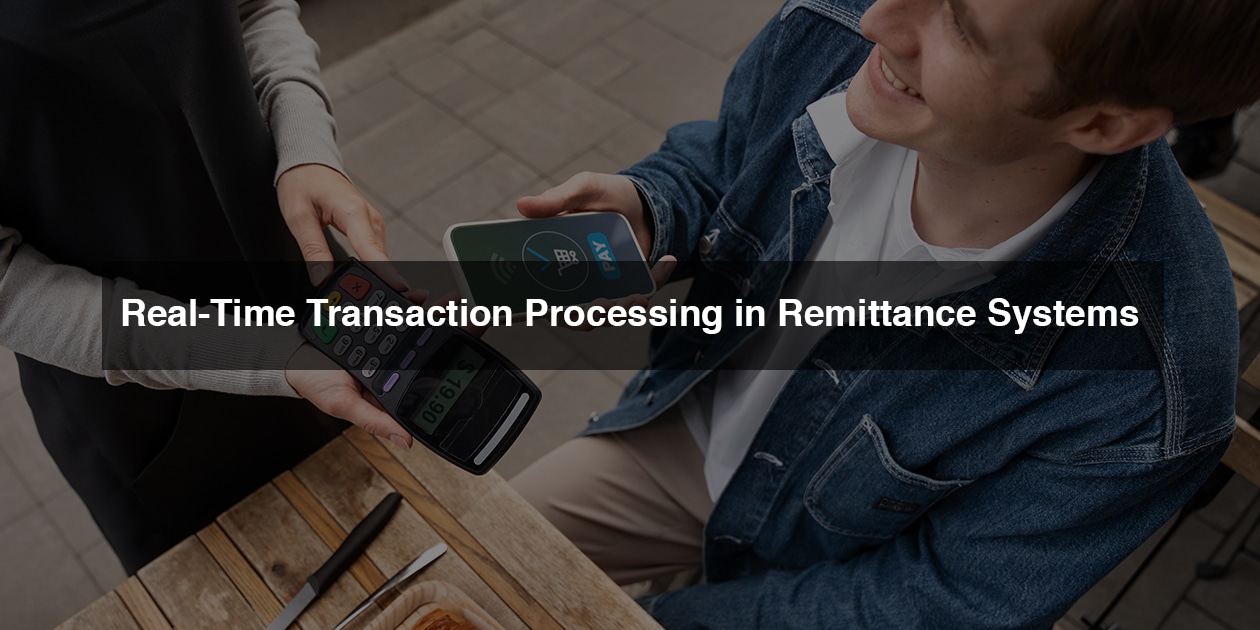
Real-time transaction processing is a system model in which each transaction is received, validated, executed, and confirmed individually and immediately typically within seconds rather than being held and processed as part of a batch at a scheduled interval.
In the context of remittance, real-time transaction processing means that when a sender initiates a cross-border money transfer, the system immediately begins executing that transaction through a chain of interconnected components: identity validation, compliance screening, FX conversion, API calls to the banking network, routing across payment rails, and settlement all within a single, continuous processing thread rather than a queued batch job.
The operative distinction is not speed alone. It is the processing model: event-driven, stateful, individual transaction execution versus time-delayed, aggregated, bulk execution. This is precisely why real-time vs batch processing payments is not a trivial comparison, it is a fundamental architectural choice.
Real-time transaction systems require fundamentally different infrastructure than batch systems, a different database model, different queue architecture, different API behavior, and different settlement mechanics. Understanding why requires understanding both sides of the equation.
Real-Time vs Batch Processing in Payments
The difference between real-time and batch processing is not merely temporal it is architectural. To understand how real-time remittance systems operate, you must first understand what they replaced and how the two models differ at a system level.
Batch Processing Explained:
In a batch processing model, transactions are collected and stored over a defined period hourly, end-of-day, or overnight and then processed together as a single grouped job. The system does not act on any individual transaction until the batch window closes and the processing run begins.
This model was dominant in traditional banking because it is computationally efficient: processing 100,000 transactions in a single run is cheaper and simpler to manage than handling 100,000 individual real-time events. Batch systems also tolerate latency by design they make no promise of immediacy.
In remittance, batch processing means a transfer initiated at 3:00 PM might not enter the processing queue until the end-of-day run at 11:00 PM. Settlement may then occur the following business day through net settlement between financial institutions.
Real-Time Processing Explained:
In a real-time payments system, each transaction triggers its own processing thread immediately upon initiation. There is no aggregation window, no queued holding state, and no dependency on a scheduled batch run. The processing engine picks up the transaction event, validates it, executes the payment instruction, and returns a confirmation all within seconds.
Real-time remittance processing depends on an event-driven architecture in which a transaction initiation fires an event that cascades through the system: compliance check → FX rate lock → API call to payment rails → routing decision → settlement instruction → confirmation signal. Each step is executed in sequence, often within milliseconds, with the system maintaining transaction state throughout.
Key Differences: Real-Time vs Batch Processing in Payments
| Dimension | Batch Processing | Real-Time Processing |
| Processing trigger | Scheduled time window | Immediate on initiation |
| Transaction handling | Aggregated, grouped | Individual, isolated |
| Latency | Hours to days | Seconds to milliseconds |
| Settlement model | Net settlement at intervals | Gross or pre-funded instant |
| Infrastructure | Scheduled jobs, flat-file processing | Event-driven, microservices, APIs |
| Error handling | Batch-level failures | Transaction-level failures with instant retry |
| Database model | Periodic writes | Real-time read/write with low-latency databases |
| Cost per transaction | Lower compute cost | Higher infrastructure investment |
Trade-offs:
Real-time transaction systems carry a higher infrastructure cost and complexity burden. They require always-on processing engines, low-latency databases, redundant API connections to payment rails, and pre-funded liquidity positions to enable instant settlement. They are less forgiving of failures a processing engine outage affects every in-flight transaction immediately rather than delaying a batch that can be retried.
Batch systems are cheaper to operate but cannot meet the expectations of modern remittance users who initiate transfers on mobile apps and expect near-instant delivery. The difference between real-time and batch payments is therefore both a user experience decision and an infrastructure commitment.
How Real-Time Transaction Processing Works in Remittance: Step by Step
Understanding how real-time transaction processing works requires tracing a single transaction from initiation to confirmation through each system layer. Here is the complete transaction flow.
Step 1: User Initiates Transfer
The transaction lifecycle begins when a sender submits a transfer through the remittance platform’s frontend — a mobile app, web interface, or API integration. The frontend captures the transaction parameters: send amount, destination currency, recipient details, and selected delivery method.
This input event is passed immediately to the backend processing engine via an API call. The transaction is assigned a unique transaction ID and enters an active processing state. No queuing occurs.
Step 2: System Validates Instantly
Within milliseconds of receiving the transaction event, the processing engine runs a multi-layer validation sequence:
- Schema validation: Are all required fields present and correctly formatted?
- Business rule validation: Does the amount comply with transfer limits? Is the corridor supported?
- KYC/AML screening: Is the sender verified? Does either party appear on sanctions lists or PEP databases? This check queries internal and third-party compliance databases via API in real time.
- Fraud scoring: Is the transaction behavior consistent with the sender’s historical pattern?
If any validation step fails, the transaction is rejected immediately and the sender receives an instant error response. This is a critical architectural difference from batch systems, where a validation failure may not surface until the batch run hours later.
Step 3: Payment Processing Begins
Once validation clears, the processing engine locks the FX exchange rate for the transaction and calculates the exact recipient amount. In real-time remittance processing, rate locking is executed at validation completion — not at initiation — to ensure the rate reflects market conditions at the moment processing begins.
The processing engine simultaneously checks liquidity: is sufficient pre-funded balance available in the destination currency to cover this transaction? In a pre-funded model, this check is a database read against the liquidity position in the relevant settlement account.
Step 4: API Triggers the Banking Network
The processing engine issues an outbound API call to the relevant payment rail or banking partner. This is the step that initiates fund movement through the external financial network.
Depending on the corridor, this API call may target:
- A local instant payment network (UPI in India, FPS in the UK, PayID in Australia, RaastPay in Pakistan)
- A partner bank’s API in the destination country
- A real-time gross settlement system operated by a central bank
The API call carries the full transaction instruction: amount, currency, recipient account details, and transaction reference. The banking network acknowledges receipt and begins its own processing sequence.
Step 5: Transaction Is Routed
Routing in real-time transaction systems is a dynamic decision made by the processing engine based on rules defined in a routing table. The engine evaluates available payment rails for the corridor, selects the optimal route based on cost, speed, and availability, and directs the transaction accordingly.
In corridors with direct bank integrations, a single API hop may reach the recipient’s bank directly. In corridors that still require correspondent banking intermediaries, the routing layer manages the multi-hop instruction chain — though modern real-time remittance systems minimize intermediary hops through direct integration strategies.
The transaction state is updated in the database at each routing decision point, maintaining a complete audit trail.
Step 6: Settlement Occurs
Settlement in real-time systems operates differently from batch settlement. There are two primary models:
Pre-funded settlement: The remittance provider holds pre-funded balances in local currency in destination markets. When a transaction clears routing, the system debits the pre-funded account and credits the recipient’s account — settlement is instantaneous because the funds are already in-country. The interbank position is reconciled separately on a net basis, but the recipient receives funds immediately.
Real-time gross settlement (RTGS): Each transaction is settled individually and irrevocably through the central bank’s settlement system in real time. No netting occurs. This model is used for high-value transfers and by operators connected directly to central bank infrastructure.
Pre-funded settlement is the dominant model in consumer remittance because it enables instant payout without waiting for interbank settlement windows.
Step 7: Instant Confirmation
Once settlement is confirmed, the processing engine sends a completion event back through the system stack. The sender receives an instant confirmation notification — via push notification, SMS, or in-app status update — and the recipient’s account is credited. The full transaction lifecycle, from initiation to confirmation, is complete within seconds in a properly architected real-time remittance system.
Real-Time Processing Architecture
Understanding how instant payment systems operate at an architectural level requires examining each layer of the system stack. The architecture of a real-time transaction system is not simply a faster version of a batch system — it is a fundamentally different design.
Event-Driven Architecture:
Real-time transaction systems are built on an event-driven model. Every transaction action — initiation, validation, rate lock, API call, routing decision, settlement, confirmation — is modeled as a discrete event. These events are emitted, consumed, and processed by independent system components.
This model enables parallel processing: validation, fraud scoring, and liquidity checks can be executed concurrently rather than sequentially, reducing total processing latency. It also enables fault isolation — a failure in one component does not cascade to others, because each component consumes events independently.
APIs:
APIs are the connective tissue of real-time payment systems. Every external integration — banking partners, compliance databases, FX providers, payment rail networks — is accessed via API. Internal system components communicate via internal APIs or message-passing interfaces.
API design in real-time transaction systems prioritizes low latency and high availability. Timeout thresholds are tightly defined. Retry logic handles transient failures without blocking the transaction thread. Webhook callbacks receive asynchronous responses from banking partners and trigger downstream processing events.
Microservices:
Modern instant payment processing architecture decomposes system functions into independent microservices: a validation service, a compliance service, an FX service, a routing service, a settlement service, a notification service. Each service is independently deployable, independently scalable, and independently maintainable.
This architecture allows high-traffic components — the validation service, for example — to be scaled horizontally without scaling the entire system. It also enables engineering teams to update individual services without system-wide deployment risk.
Queue Systems:
Message queues are a critical infrastructure component in real-time remittance systems. Queues — implemented via systems such as Apache Kafka, RabbitMQ, or cloud-native equivalents — act as buffers between microservices, enabling asynchronous communication and preventing processing bottlenecks.
When transaction volume spikes, queues absorb the load, ensuring that transactions are processed in order without overwhelming downstream services. Dead-letter queues handle failed events, enabling retry and error investigation without data loss. Queue depth is a key operational metric — rising queue depth signals processing latency before it becomes visible to users.
Databases:
Real-time transaction processing imposes strict requirements on database performance. Batch systems can tolerate periodic writes and slower read performance. Real-time systems require sub-millisecond read/write latency, high concurrency handling, and ACID compliance to ensure transaction integrity.
Common database patterns in real-time payment systems include: primary relational databases for transaction records and audit logs; in-memory data stores (Redis) for session state, rate-limiting, and liquidity position caching; and event stores for the event-driven transaction log. Database replication and failover are mandatory — a database outage in a real-time system has immediate user-visible impact.
Payment Infrastructure Behind Real-Time Systems
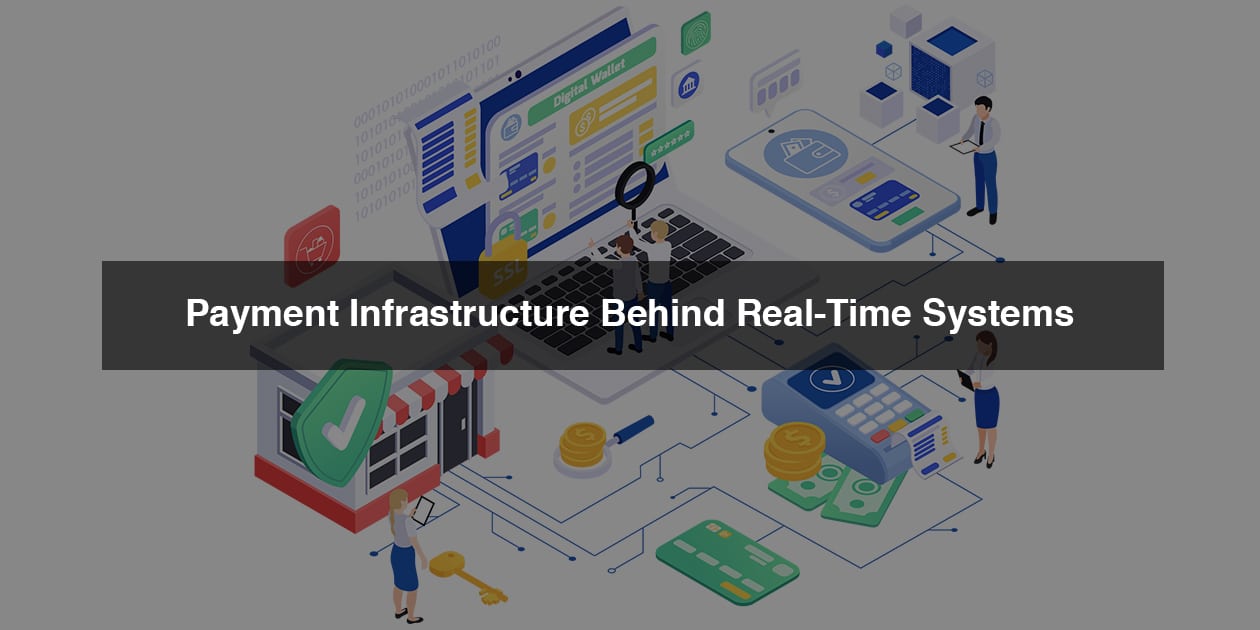
How instant payment systems operate depends heavily on the payment infrastructure they connect to. The processing engine is only as fast as the rails it rides.
Payment Rails:
Payment rails are the networks that carry payment instructions between financial institutions. In real-time remittance systems, the payment rails determine whether a transfer can settle instantly or whether it is constrained by network-level latency and batch settlement cycles.
Key instant payment rails include: UPI (India), which settles in seconds 24/7; FPS (UK Faster Payments), which enables near-instant domestic settlement used as the last-mile delivery network for inbound remittances; SEPA Instant (Europe); RTP (US Real-Time Payments network); and PayID (Australia). In corridors where these rails exist, remittance operators connect directly via API to enable end-to-end real-time delivery.
Instant Networks:
Beyond national payment rails, real-time remittance systems leverage bilateral and multilateral instant payment networks — agreements between operators and banks that enable real-time API-based fund delivery outside traditional correspondent banking structures. Mobile money networks (M-Pesa, bKash, Easypaisa, Wave) function as instant delivery networks in markets where bank account penetration is limited.
Bank Integrations:
Direct API integrations with destination-country banks are the highest-performance delivery model in real-time remittance processing. When the remittance operator holds a direct API connection to the recipient’s bank, transaction delivery bypasses intermediary routing entirely, reducing latency to seconds.
Building and maintaining these integrations requires significant engineering investment and regulatory licensing in each market but they are the foundation of genuinely instant payment processing architecture.
Settlement in Real-Time Systems
Settlement mechanics are where the difference between batch and real-time models becomes most practically significant in remittance operations.
Pre-Funding:
Pre-funding is the mechanism that makes instant payout possible in real-time remittance systems. The operator maintains funded accounts denominated in local destination currency with banking partners in key markets. When a transaction completes routing, the system debits the pre-funded account and credits the recipient immediately.
Pre-funding decouples the user-facing settlement experience from the interbank settlement cycle. The recipient receives funds in seconds; the operator reconciles its interbank positions separately through periodic net settlement with banking partners. This is how operators like Wise, Remitly, and others deliver seconds-fast transfers while operating within traditional banking infrastructure constraints.
Liquidity Management:
Liquidity is the operational constraint on real-time remittance processing at scale. Pre-funded accounts must be maintained at sufficient levels to cover transaction volume without over-capitalizing in any given currency. Liquidity management systems monitor account balances in real time, trigger top-up workflows when balances fall below thresholds, and project forward liquidity requirements based on transaction volume patterns.
A liquidity shortfall in a high-volume corridor can cause real-time transactions to fail or be delayed making liquidity monitoring a critical operational function in any real-time payments system.
Challenges in Real-Time Transaction Processing
Deploying and operating a real-time remittance system introduces a specific set of infrastructure and operational challenges that batch systems do not face.
Latency:
Latency is the primary performance metric in real-time transaction systems. Every network hop, API call, and database query contributes to end-to-end transaction latency. In a global remittance system, API calls to banking partners in remote markets, compliance database queries, and FX provider calls each add latency that accumulates through the processing chain.
Minimizing latency requires geographic distribution of processing infrastructure (deploying processing engines close to destination markets), API response time optimization, aggressive caching of frequently accessed data (exchange rates, compliance check results for known senders), and asynchronous processing of non-blocking steps.
Failures and Error Handling:
In batch systems, failures affect an entire batch and are resolved before the next run. In real-time transaction systems, failures are transaction-level and immediate. A banking partner API returning a timeout, a compliance database becoming temporarily unavailable, or a payment rail experiencing downtime all create individual transaction failures that must be handled in real time.
Robust real-time systems implement: automatic retry with exponential backoff for transient failures; fallback routing to alternative payment rails when primary rails fail; dead-letter queues for failed events requiring manual investigation; and real-time alerting to operations teams when failure rates exceed defined thresholds.
Scalability:
Real-time processing infrastructure must handle peak transaction loads without performance degradation. Remittance systems experience significant volume spikes — around major holidays, salary payment cycles, and in response to exchange rate movements. Infrastructure that performs adequately at average load may fail under peak conditions.
Horizontal scaling of microservices, auto-scaling policies tied to queue depth and API response times, and load testing against peak volume scenarios are the primary tools for managing scalability in real-time transaction systems.
Use Cases of Real-Time Remittance
Understanding the practical applications of real-time remittance processing clarifies why the architectural investment is justified.
Migrant worker transfers: Workers sending earnings home weekly or biweekly require reliable, fast delivery. Real-time remittance processing ensures recipients access funds immediately rather than waiting days for batch-cycle settlement — critical in households where the transfer is primary income.
Emergency transfers: Medical emergencies, disaster response, and time-critical financial needs cannot wait for batch processing windows. Real-time systems provide the immediacy these use cases require.
Gig economy payouts: Platforms paying international contractors need real-time payment processing to deliver earnings promptly. Batch payout delays damage contractor satisfaction and platform reputation.
SME cross-border payments: Small businesses making supplier payments internationally benefit from real-time confirmation, which enables faster order fulfillment and supply chain coordination.
Mobile money markets: In markets where mobile wallet penetration exceeds bank account penetration, real-time remittance systems connected to local mobile money networks enable instant wallet credit — making financial inclusion practically achievable.
Real-Time Processing System Requirements Checklist
For operators building or evaluating a real-time remittance system, these are the minimum system requirements:
- API infrastructure: Low-latency, high-availability API connections to compliance providers, FX sources, and banking partners
- Low-latency processing engine: Event-driven architecture capable of processing individual transactions within defined SLA thresholds (typically under 10 seconds end-to-end)
- Queue system: Message queue infrastructure for inter-service communication, load absorption, and failure handling
- Pre-funded liquidity: Funded accounts in destination markets sufficient to cover peak transaction volume
- Real-time monitoring: Transaction monitoring dashboards, latency alerting, queue depth monitoring, and failure rate tracking
- Compliance API integrations: Real-time KYC/AML screening with sub-second response times
- Fallback routing: Alternative payment rail options for corridor resilience
- Database infrastructure: Low-latency primary database with in-memory caching layer
Frequently Asked Questions
How does real-time transaction processing work differently from standard bank transfers?
Standard bank transfers typically operate on batch processing cycles; transactions are collected and processed at scheduled intervals, often with next-day or multi-day settlement. Real-time transaction processing handles each transaction individually and immediately, executing validation, routing, and settlement within seconds through an event-driven processing engine connected to instant payment rails.
What is the difference between real-time and batch processing in payments?
The core difference is architectural. Batch processing aggregates transactions and processes them at scheduled intervals, accepting latency as a design feature. Real-time processing executes each transaction immediately upon initiation, requiring always-on infrastructure, instant API connections, and pre-funded liquidity to enable instant settlement. The two models differ in processing model, database requirements, error handling, infrastructure cost, and settlement mechanics.
How do instant payment systems operate in markets without real-time payment rails?
In corridors without local instant payment rail infrastructure, operators use direct bank API integrations, mobile money network connections, or pre-funded agent networks to simulate real-time delivery. The processing engine side can operate in real time even when the last-mile delivery relies on legacy banking infrastructure though true end-to-end real-time performance requires real-time capability at every system layer.
Why does real-time remittance sometimes experience delays despite the system design?
Several factors can introduce latency in otherwise real-time systems: compliance screening flags requiring manual review, banking partner API timeouts or outages, liquidity shortfalls in destination currency accounts, peak-volume queue depth buildup, and payment rail availability windows. A real-time processing architecture eliminates batch-cycle delays but cannot eliminate all sources of latency — particularly those introduced by external system dependencies.
What are the main system requirements for real-time remittance processing?
The critical requirements are: a low-latency event-driven processing engine, real-time API integrations with compliance providers and banking partners, a message queue system for inter-service communication, pre-funded liquidity in destination markets, low-latency database infrastructure, and real-time monitoring and alerting systems. Without all of these components, a system cannot deliver genuine real-time performance at scale.
How does settlement work in real-time remittance systems?
Most real-time remittance operators use a pre-funded settlement model: they hold pre-funded accounts in destination-country currency with local banking partners, enabling immediate credit to the recipient upon transaction completion. The interbank position between the operator and their banking partners is reconciled separately through net settlement — typically daily. This decouples user-facing settlement speed from interbank settlement cycles, enabling instant recipient payouts within traditional banking infrastructure