
ISO 20022 is the global standard financial institutions use to exchange electronic financial information in a common, structured format. Its XML messages carry richer data about who pays, who receives and why. Since 22 November 2025, it has been the required format for in-scope cross-border payments on Swift.
If you run a money transfer business, this standard reaches you through your banks and payout partners, even when you never send a Swift message yourself. Swift is the member-owned cooperative that runs the global financial messaging network. This guide explains what ISO 20022 is, how it works, where the migration stands today, and what it means for cross-border payments. We build remittance software for money service businesses (MSBs), so we focus on the parts that touch your data.
Key takeaways
- Definition: ISO 20022 is a global, open standard for financial messages, built on one methodology and one central repository.
- Status: As of August 2026, more than 98% of payment instructions on Swift use ISO 20022.
- Open item: Swift deferred its structured address deadline on 27 August 2026 and will update by December 2026.
- For MSBs: The data you capture at the start of a transfer flows into the message your bank sends.
ISO 20022 in Simple Terms

ISO 20022 is a multi-part international standard from ISO Technical Committee 68, the committee for financial services. The ISO 20022 website describes it as a single standardization approach for all financial standards initiatives. It covers a methodology, a process, and a repository.
The standard grew out of an earlier securities messaging standard, ISO 15022. Swift acts as the Registration Authority, which keeps and publishes the central repository of ISO 20022 content. A Registration Management Group oversees the process at the top level. Standards Evaluation Groups review new items for areas such as cards, foreign exchange, and trade finance.
ISO 20022 is not only for payments. It also covers securities trading and settlement, card transactions, and other financial information.
How ISO 20022 Works?
ISO 20022 starts with a business model and a shared data dictionary. From that model, the standard produces messages in XML syntax. Each message has named fields for specific data, such as the debtor, the creditor, the agents involved, and the remittance information.
Messages belong to families, each with a four-letter prefix:
| Family | What it covers | Example |
| pain | Payment initiation between a customer and a bank | pain.001, customer credit transfer initiation |
| pacs | Payment clearing and settlement between banks | pacs.008, customer credit transfer; pacs.009, bank credit transfer |
| camt | Cash management and account reporting | camt.053, account statement |
| acmt and admi | Account management and administrative messages | Support and status exchanges |
Swift uses the term MX for its ISO 20022 messages. Swift’s CBPR+ guidance maps the main payment messages to the older MT formats like this:
| Legacy MT message | ISO 20022 MX equivalent |
| MT 101, request for transfer | pain.001 |
| MT 103, customer credit transfer | pacs.008 |
| MT 202 and MT 202 COV, bank transfer | pacs.009 and pacs.009 COV |
The move from MT 101 to pain.001 follows Swift’s wider migration timeline, so confirm timing with your bank.
ISO 20022 vs. MT Messages
MT and ISO 20022 messages can carry the same payment, but they organize the data differently. Older MT messages use condensed fields with limited room for detail. ISO 20022 messages give each piece of information its own place. That structure lets banks and screening tools read the data without guessing.
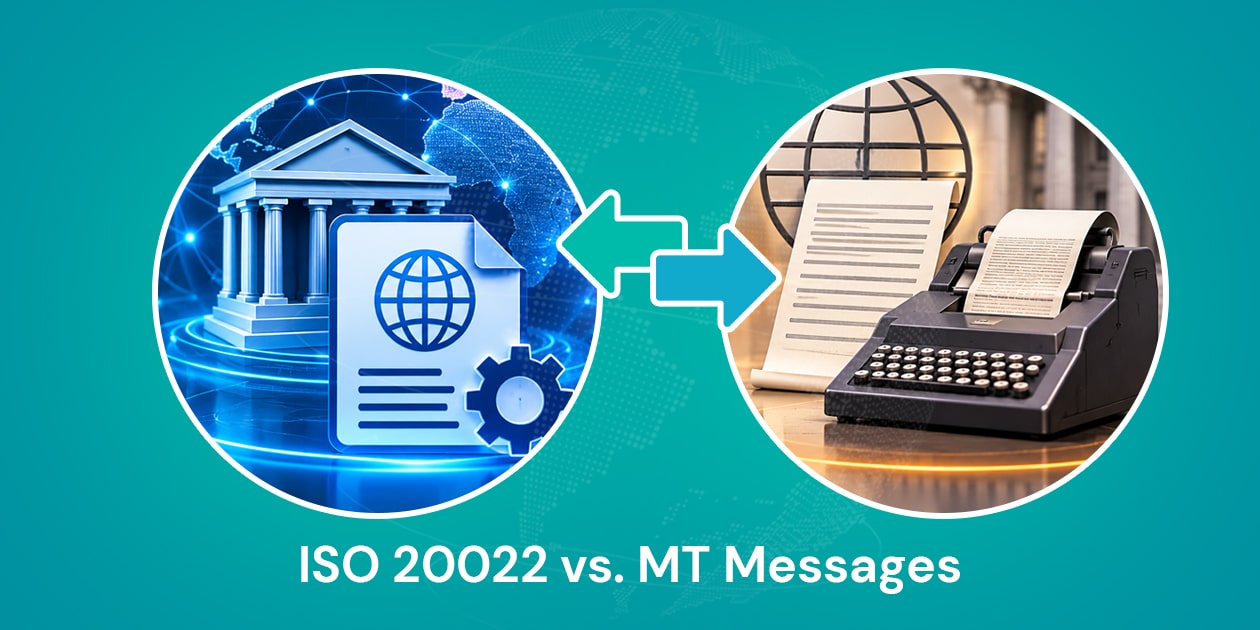
| Feature | MT messages | ISO 20022 (MX) messages |
| Format and ownership | Swift’s own tag-based text format | An open international standard written in XML |
| Data layout | Condensed fields with limited room for detail | Named fields for each piece of data |
| Addresses and party details | Mostly free-text lines | Structured, hybrid, or unstructured address formats, with unstructured being phased out |
| Screening and automation | Systems often have to interpret free text | Systems can read each field directly |
For an MSB, the practical difference is the data, not the file format. Your bank can only send rich, structured data if you give it rich, structured data first.
Unstructured, hybrid, and structured addresses
Addresses are where the change shows most clearly. Here is an illustrative example of one address in the three formats:
| Format | How the address is held |
| Unstructured | One free-text line: 250 Main Street, Suite 4, Austin, TX 78701, United States |
| Hybrid | Town: Austin. Country: US. Address line: 250 Main Street, Suite 4, 78701 |
| Structured | Street name: Main Street. Building number: 250. Room: Suite 4. Postal code: 78701. Town: Austin. Country subdivision: TX. Country: US |
A hybrid address puts town and country in their own fields and keeps the rest in free-text lines. A structured address splits every part into its own field. Swift’s rule change in this area concerns unstructured addresses, and the hybrid and structured formats are already accepted on the network.
Why ISO 20022 Matters?
Swift names three practical gains from structured data: greater straight-through processing, more effective compliance screening, and better transparency across the payments chain. The same structure supports the G20 goal of better data quality in cross-border payments. It also supports the harmonized data requirements from the Committee on Payments and Market Infrastructures (CPMI). The revised Recommendation 16 on payment transparency, from the Financial Action Task Force (FATF), the global anti-money-laundering standard setter, relies on the same kind of data.
For a payer or payee, the goal is simple. Payments should carry the right information, so they clear faster and stop less often for manual review.
Who ISO 20022 Affects?
Swift says the change carries implications for banks, corporates, software vendors, and market infrastructures. Banks must capture and validate correct data from their retail and corporate clients across every channel. Their clients then need to supply that data cleanly. Money service businesses sit in that chain as clients of banks and as the origin of many consumer transfers.
ISO 20022 Migration Timeline: Where Things Stand?
| Date | Milestone |
| March 2023 | Swift MT and ISO 20022 coexistence begins for cross-border payments |
| 14 July 2025 | Federal Reserve moves the Fedwire Funds Service to ISO 20022 in a single day |
| 22 November 2025 | Swift CBPR+ coexistence ends, and ISO 20022 becomes the format for in-scope payments |
| 27 August 2026 | Swift defers the structured address deadline that was set for 14 November 2026 |
| By December 2026 | Swift will update the community on timing and approach |
| 12 June 2027 | New date for the deferred Standards Release 2026 changes outside payments |
Swift’s planned rule, set in 2023 as part of Standards Release 2026, was to stop accepting fully unstructured postal addresses. At a minimum, town and country would sit in their own fields for all agents and parties. In August 2026, Swift agreed to extend that timeline after several communities and market infrastructures asked for more time. Structured and hybrid addresses already work on the network today.
ISO 20022 and Cross-Border Payments
Cross-border payments are where ISO 20022 matters most. CBPR+ (Cross-Border Payments and Reporting Plus) is a workgroup of payments experts that writes the global usage guidelines for ISO 20022 on the Swift network. Those guidelines define how banks construct and validate messages for cross-border payments and reporting. In-scope payments between your bank and its correspondent now travel as pacs.008 and pacs.009 messages instead of MT 103 and MT 202.
What this means for an MSB?
Most MSBs do not connect to Swift directly. Your bank, payment processor, or payout partner sends the message. Yet the content of that message starts with you.
Swift says institutions must source address data at origin, so Swift cannot build a contingency fix for those that fall behind. The same logic applies to a remittance. The sender and beneficiary details you collect at onboarding and at checkout become the debtor and creditor fields in the bank’s message.
Three habits help:
- Capture addresses in separate fields. Store street, town, postal code, and country apart from each other. A single free-text box makes structuring harder later.
- Collect complete party data. Full names, country, and a clear purpose and reference for each transfer give banks and screening tools more to work with.
- Ask your banks what they need. Swift advises corporates to talk to their banks early about address requirements and testing. MSBs should do the same.
How we fit in?
Our platform is API-first, and it integrates with banks, payment processors, payout partners, compliance providers, and accounting systems. Because we sit between your front end and those partners, the data you collect travels through one place. If you want to map how your sender and beneficiary details reach each partner, talk to our team, and we will walk through it with you.
Case Studies: Two Large Migrations
Fedwire Funds Service, United States
Federal Reserve Financial Services moved the Fedwire Funds Service to ISO 20022 on a single day, 14 July 2025. The original date was 10 March 2025, but the Federal Reserve rescheduled it after it weighed industry requests and customer readiness. The Fedwire highlights that processing speed stayed the same after the cutover. After the switch, customers could retrieve messages only in the ISO 20022 format, and prior-day retrievals were not supported.
Lesson: a large system can change formats in one day, but the date moves when the industry is not ready.
Swift CBPR+, global network
Swift reports 97% adoption after the end-of-coexistence weekend in November 2025. More than 98% of payment instructions used the ISO 20022 format by August 2026. Yet Swift’s April 2026 data showed that about 61% of payments still included unstructured debtor addresses. In August 2026, Swift extended the structured address timeline.
Lesson: moving to the new format was the easy part. Data quality at the point of origin is the hard part, and that is where MSBs, banks, and software providers meet.
Common ISO 20022 Challenges
- Address quality. Free-text addresses must become structured or hybrid addresses.
- Moving dates. Deadlines have shifted, so teams should track the Swift announcements and their own banks’ timelines.
- Uneven alignment. Swift notes that some market infrastructures keep different timelines from CBPR+, which creates interoperability questions.
- Customer data. Banks depend on channels and clients to supply correct data from the start.
Frequently Asked Questions
1. What is ISO 20022?
ISO 20022 is a global standard for exchanging electronic financial information between financial institutions. It uses XML messages and a shared data dictionary to carry structured, detailed data. Payments, securities, cards, and other financial information all use it, and Swift now requires it for in-scope cross-border payment instructions.
2. What is ISO 20022 in simple terms?
In simple terms, ISO 20022 is a shared language for financial messages. Instead of one crowded line of text, each part of a payment, such as the payer, the recipient, and the reason, gets its own labeled field. Banks and screening tools can then read the data more reliably.
3. What is the difference between ISO 20022 and MX?
MX is the name Swift uses for ISO 20022 messages on its network. ISO 20022 is the underlying standard, and MX messages, such as pacs.008 and pain.001, are the versions Swift carries. Other networks and payment systems use ISO 20022 without the MX label.
4. ISO 20022 vs. MT: what is the difference?
MT is Swift’s older tag-based message format, while ISO 20022 is an open XML standard with named fields for each data point. MT messages squeeze details into condensed fields. ISO 20022 messages carry richer, structured data, so banks can screen and process payments with less manual review.
5. Is ISO 20022 a cryptocurrency?
No. ISO 20022 is a messaging standard, not a cryptocurrency, coin, or token. It defines how banks and other institutions format and exchange financial data. It does not create, store, or move value by itself, and it applies to messages about payments in any currency.
6. Who manages ISO 20022?
ISO Technical Committee 68 develops the standard. A Registration Management Group oversees registration, and Swift acts as the Registration Authority that keeps the central repository of ISO 20022 content. Standards Evaluation Groups review new items for areas such as payments, securities, cards, foreign exchange, and trade finance.
7. When did Swift’s MT and ISO 20022 coexistence end?
Coexistence for cross-border payments and reporting ended on 22 November 2025. ISO 20022 is now the required format for in-scope cross-border payment instructions on the Swift network. As of August 2026, more than 98% of payment instructions on Swift already use the new format.
8. Is the November 2026 structured address deadline still in force?
No. On 27 August 2026, Swift deferred all payments changes in Standards Release 2026, including the removal of unstructured addresses. Swift said it will update on timing by December 2026 at the latest. Structured and hybrid addresses are already accepted, so you can keep migrating now.
9. Does ISO 20022 apply in the United States?
Yes. The Federal Reserve moved the Fedwire Funds Service to ISO 20022 on 14 July 2025, and it aligned the format for the FedNow Service as far as possible. U.S. banks also use the standard for in-scope cross-border payments on the Swift network.
10. Does ISO 20022 affect money service businesses?
Yes, indirectly. Banks and payout partners send the ISO 20022 messages, but they rely on the sender and beneficiary data an MSB collects. Clean, structured data at origin, such as separate address fields and complete party details, helps payments clear without manual review.
11. What data does ISO 20022 add to a payment?
ISO 20022 messages can carry detailed information on parties, accounts, addresses, references, and remittance details in dedicated fields. This structure supports automation and compliance screening, because systems can read each piece of data directly instead of parsing free text.
Talk to Us About Your Transfer Data
Ready to see how your sender and beneficiary data flows to your banks and payout partners? Sign up to start, or contact us for a conversation about your corridors. You can also call +1 646-722-9500 or email info@remitanywhere.com.