
Tap a card. Tap a phone. Two seconds later, the payment is done. That’s contactless payment, and the technology behind most of it is called NFC Near Field Communication. It’s become so common that many people use it every day, without knowing its name or how it works.
For remittance and money transfer businesses, NFC isn’t just a checkout convenience. It’s increasingly part of how funds get disbursed, especially to customers without easy access to a bank branch. This guide covers what NFC actually is, how contactless payments work, and what the data says about adoption. It also covers why this technology matters for agent networks and money transfer operators building on platforms like Remit Anywhere.
What Is NFC (Near Field Communication)?
NFC is a short-range wireless technology. It lets two devices exchange data when held close together, usually within a couple of inches. It’s a close relative of RFID (radio-frequency identification), the tech used in building access badges and inventory tags. But NFC is built specifically for secure, two-way communication over very short distances.
When people say “contactless payments,” they almost always mean NFC in action. A contactless card, a phone loaded into a mobile wallet, or a payment-enabled smartwatch all use NFC chips. They communicate with a payment terminal the moment they’re tapped or held near it.
How Does NFC Power Contactless Payments?
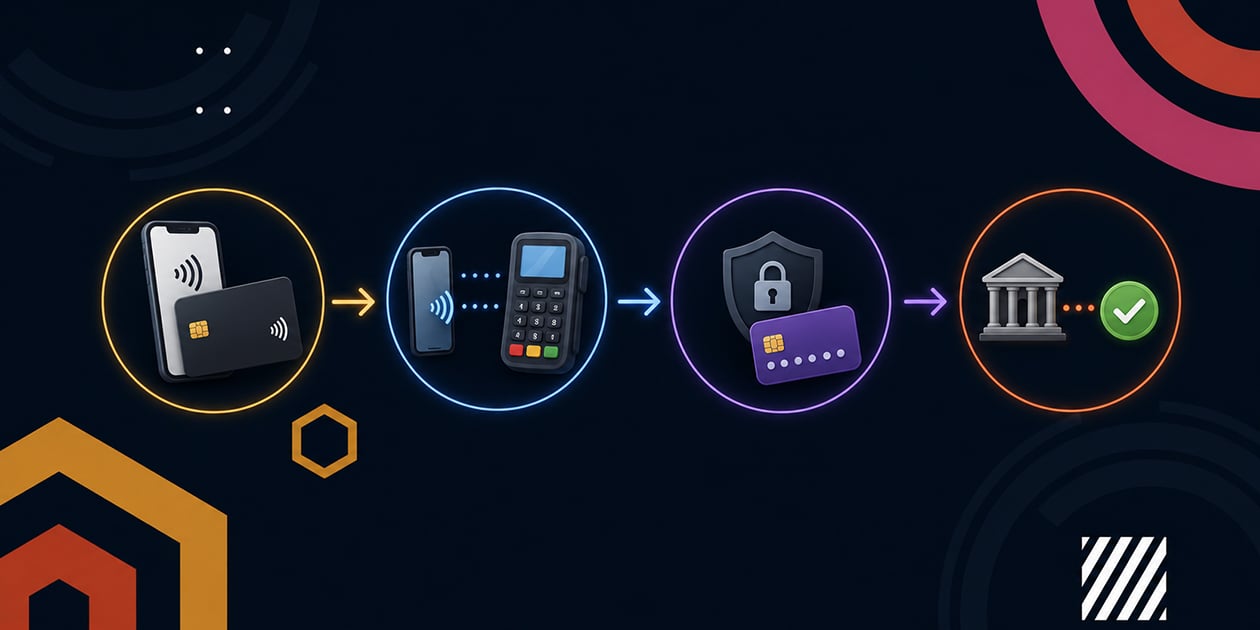
The mechanics happen in under a second, but a few distinct steps take place:
[Image: NFC transaction flow diagram tap, radio exchange, tokenization, authorization. A version of this diagram is just for reference, please re-create it for more credibility. “Diagram showing the four steps of an NFC contactless payment: tap the card or phone near a terminal, exchange a radio signal, generate a one-time token, and authorize the transaction.”]
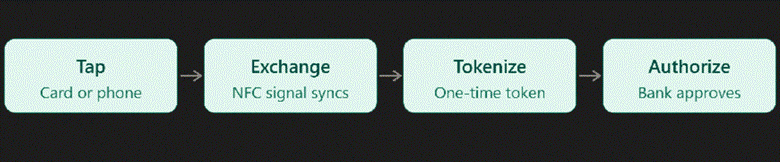
- Proximity trigger. The customer holds their card, phone, or wearable within a couple of inches of an NFC-enabled terminal.
- Radio handshake. The terminal and the device exchange data over a short-range radio frequency (NFC runs at 13.56 MHz).
- Tokenization. Instead of sending the actual card number, the device generates a one-time token that stands in for the real account details. This token is useless to anyone who intercepts it. It can’t be reused for another transaction.
- Authorization. The payment network checks the token and approves or declines the transaction, the same way it would for a chip or swipe payment.
The entire exchange usually takes two to three seconds. That’s noticeably faster than inserting a chip card, which commonly takes eight to twelve seconds including the wait for the terminal to read and release it, according to Sleft Payments’ 2026 contactless payment trend research.
Contactless Payments vs. Other Payment Methods
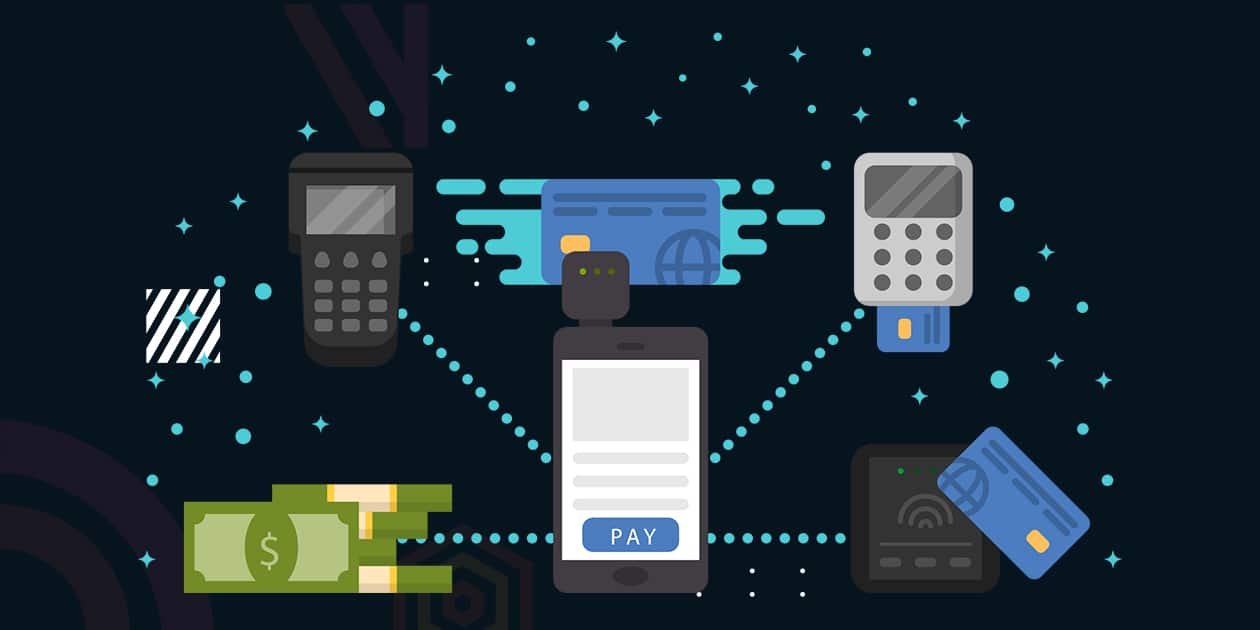
NFC isn’t the only way to pay without cash or a card swipe. It’s worth knowing how it compares to the alternatives:
- NFC (tap-to-pay): Fastest checkout experience. Works with cards, phones, and wearables. Needs an NFC-enabled terminal.
- QR codes: Useful where NFC terminals are less common or costly to deploy, since a QR code only needs a printed sticker and a smartphone camera.
- SoftPOS: Turns a regular smartphone into a payment terminal by reading NFC signals through the phone’s own hardware. This lets small merchants and independent agents accept contactless payments without buying a dedicated card reader.
For remittance agents and money transfer operators expanding into new markets, this matters directly. SoftPOS and QR-based options can extend contactless acceptance to agent locations that would otherwise need to invest in traditional POS hardware.
NFC and Contactless Payments by the Numbers
Adoption has moved from early-adopter territory to the default way most people pay in many markets. A few figures worth knowing:
- An estimated 94% of smartphones worldwide now ship with NFC hardware built in. The infrastructure for contactless payments already exists in most pockets, whether or not people use it yet, according to ElectroIQ’s NFC payment market research.
- Roughly 1.3 billion people globally currently use NFC-based payments in some form, per the same ElectroIQ data. Mobile payment users overall are projected to approach 1.7 billion within the next couple of years.
- Industry researchers project that by 2026, roughly 81% of payment cards issued will support contactless payment. That’s up sharply from a decade ago, when contactless cards were the exception, not the rule.
- In Europe, contactless now accounts for around 85% of in-store retail transactions. In the U.S., that figure sits closer to 58–65% of in-store digital transactions, depending on the retailer and region, according to Andersen’s 2026 contactless payment statistics.
- Digital wallet usage Apple Pay, Google Pay, and similar apps has grown by roughly 40% since 2023, according to Sleft Payments’ research citing Federal Reserve payments data.
- Market analysts at CoinLaw put the global NFC payments market at roughly $43 billion in 2025, with Precedence Research projecting figures as high as $200+ billion by the mid-2030s. Most forecasts show a compound annual growth rate near 19–20%.
These figures vary somewhat between research firms, since methodology and market definitions differ. But the direction is consistent across every source: contactless adoption is speeding up, not leveling off.
Why NFC and Contactless Payments Matter for Remittance and Money Transfer Businesses
Contactless technology started in retail checkout lines. But its impact on remittance and cross-border money transfer runs deeper than convenience.
Disbursement to unbanked and underbanked recipients. NFC-enabled prepaid cards can be issued without requiring a traditional bank account. That matters directly for remittance operators, since a large share of remittance recipients live in markets with limited banking access. A prepaid NFC card linked to a mobile wallet lets a recipient collect and spend remitted funds without ever visiting a bank branch, a use case industry research on NFC card issuance specifically highlights as a driver of financial inclusion.
Faster agent-network transactions. For agent-based money transfer operators, contactless technology speeds up in-person transactions at agent locations. It cuts the two-to-three-second tap time against the ten-plus seconds a chip transaction often takes. At high-volume agent locations, that difference adds up across a full day.
Lower-cost expansion into new markets. SoftPOS lets an agent accept contactless disbursements using a standard smartphone. The operator doesn’t need to ship and maintain dedicated card terminals at every location. This lowers the cost of expanding into new corridors and emerging markets, where hardware logistics are a real operational cost.
Government and institutional disbursement programs. NFC-based prepaid cards are also used for aid disbursement, payroll for informal workers, and other institutional payment programs. This expands NFC’s role beyond person-to-person remittance into broader financial inclusion.
Is NFC Safe? A Look at Contactless Payment Security
Security is the most common concern people raise about contactless payments. It’s a fair question, given how casual a tap-to-pay transaction feels compared to entering a PIN.
In practice, NFC transactions carry several layers of protection:
- Tokenization means the actual card or account number is never sent. Even if the radio signal were intercepted, the token captured would be useless for a future transaction, a mechanism explained in detail by Square’s guide to NFC payment security.
- Short range limits how far away a transaction can start typically a couple of inches. This makes it very hard for an attacker to skim a payment from a distance.
- EMV certification applies the same chip-card security standards to contactless payments. The underlying protection isn’t weaker just because the card didn’t touch the terminal.
Some of the newest NFC cards also add biometric checks, like a built-in fingerprint sensor. This adds another layer of protection for higher-value transactions relevant for remittance, where a single transaction might represent a big share of a recipient’s monthly income.
The Future of NFC and Contactless Payments
A few trends are shaping where this technology goes next:
- Wearables and IoT devices:
Smartwatches, rings, and even connected vehicles increasingly ship with NFC payment built in. This extends “tap to pay” beyond cards and phones.
- Biometric payment cards.
Cards with embedded fingerprint sensors are moving from pilot programs to wider issuance. This adds a layer of in-person verification without a PIN pad.
- SoftPOS expansion.
As software-based point-of-sale adoption grows, especially among small merchants and independent agents, the barrier to accepting contactless payments keeps dropping. That trend matters directly for remittance agent networks in cost-sensitive markets.
How Remit Anywhere Supports Contactless-Ready Remittance Operations
Contactless and NFC-based disbursement isn’t a separate feature bolted onto a money transfer platform. It depends on the same capabilities that make any modern remittance operation work: flexible integrations, real-time transaction visibility, and agent tools that adapt as disbursement methods change. Here’s how Remit Anywhere’s platform connects to each piece:
API integrations with payout and card partners. Remit Anywhere’s platform is built API-first, designed to connect with banks, payment processors, and payout partners. That same integration layer lets an operator add NFC-enabled card issuance or a new disbursement partner without rebuilding core infrastructure. The API connects to new partners as your corridors expand, instead of needing custom development each time.
Real-time tracking across disbursement methods. Whether a recipient collects funds via cash pickup, bank deposit, or an NFC-enabled prepaid card, Remit Anywhere’s real-time tracking gives both the operator and the sender visibility into transaction status. That consistency matters as operators add contactless disbursement, since agents and back-office staff work from one system instead of switching tools per payout type.
Agent tools built for in-person transactions. Remit Anywhere’s Agent Remittance Manager (ARM) and Mobile Agent Remittance Manager (m-arm) support the in-person side of money transfer exactly where contactless technology has the most direct impact on speed. As agent locations adopt SoftPOS or NFC-capable devices, those transactions still flow through the same agent management and compliance tools operators already use.
Compliance workflows that scale with new disbursement channels. Adding a new payout method, including NFC-based cards, means extending KYC and AML checks to that channel too. Remit Anywhere’s compliance-first workflows and automated risk scoring apply consistently across channels. Expanding into contactless disbursement doesn’t mean building a parallel compliance process from scratch.
For money transfer operators, banks, and fintech startups evaluating remittance software, the practical question is simple: can the platform absorb new disbursement methods as customer expectations shift, without a multi-month integration project each time? See our About Us page for more on the platform’s architecture, or review current plans and pricing to see what fits your business.
Frequently Asked Questions
1. What does NFC stand for?
NFC stands for Near Field Communication, a short-range wireless technology that lets two devices exchange data when held close together, typically within a couple of inches.
2. Is NFC the same thing as contactless payment?
Not exactly. NFC is the underlying technology. Contactless payment is one of its most common applications, alongside other uses like access badges and ticketing.
3. Are contactless payments safe?
Yes, when used with standard security features. Tokenization, short transmission range, and EMV-level protection work together to keep contactless transactions secure. Security is generally on par with chip card payments.
4. How is NFC useful for remittance and money transfer businesses?
NFC-enabled prepaid cards let remittance operators pay out funds without requiring a traditional bank account. That matters in markets with limited banking access. NFC also speeds up in-person transactions at agent locations and can lower hardware costs through SoftPOS-based acceptance.
5. Do all smartphones support NFC?
Most modern smartphones do. Industry estimates put NFC-equipped smartphone penetration at roughly 94% worldwide, and that figure continues to climb as older devices are phased out.
6. What’s the difference between NFC and QR code payments?
NFC uses short-range radio communication and requires an NFC-enabled terminal. QR codes only require a printed code and a smartphone camera, making them a lower-cost option in markets where NFC terminal deployment is limited.
Ready to Modernize Your Money Transfer Business?
If your organization is evaluating modern disbursement methods, including contactless and card-based payouts, request a demo to see how Remit Anywhere’s platform fits your corridors and customer base. Have questions first? Check our FAQ page or contact our team directly.