
Every payment leaves a trail in several places at once: the provider’s ledger, the gateway or processor report and the bank statement. When those records disagree, someone has to find out why.
That job grows with volume. Nacha reports that the ACH Network alone carried 35.2 billion payments worth $93 trillion in 2025, up nearly 5% in volume from 2024. Each of those payments has to be matched to a record somewhere, and payment reconciliation is the process that does it.
At Remit Anywhere, we build remittance software for money transfer businesses, so we treat reconciliation as a data problem first. Every transfer needs one clear record that ties together the sender’s payment, the fees, the exchange rate, the partner settlement and the payout. Getting that record right is what separates a quick, clean reconciliation from a long investigation.
Key takeaways
- Payment reconciliation is the process of matching transaction records across internal systems, payment processors and bank statements to confirm that every payment is recorded and settled correctly.
- Reconciliation usually follows settlement. Settlement moves the money, and reconciliation proves the records agree with it, although real-time payments are often matched as they clear.
- Financial institutions face extra pressure from regulators, partner banks and customers, because a mismatch can become a customer error, a compliance finding or a funds shortfall.
- Automated payment reconciliation matches transactions as data arrives, so finance teams spend their time on exceptions instead of spreadsheets.
Payment Reconciliation Meaning
Payment reconciliation is the process of checking that all transactions are correctly recorded and settled, and that the revenue on your books matches the cash that reached your bank account. In other words, it compares what your records say happened with what the processors and banks say happened.
The reconciliation of payments definition applies to both directions of money. You reconcile payments you receive from customers and payments you send to recipients, partners and suppliers. A transaction counts as reconciled only when the ledger entry, the processor or partner record and the bank movement all agree on the amount, the date and the reference.
Payment Reconciliation vs. Settlement vs. Bank Reconciliation:
These three terms are easy to mix up. Each one answers a different question.
| Term | What it is | Question it answers |
| Settlement | The actual transfer of funds between the parties to complete a transaction | Did the money move? |
| Payment reconciliation | Matching individual transactions across internal records, processor reports and bank deposits | Does every payment match across all records? |
| Bank reconciliation | Matching the general ledger balance to the bank statement | Does the account balance agree with the bank? |
For most payments, settlement comes first. Once funds have moved, payment reconciliation verifies the records tied to that transaction, such as invoices, receipts and statements, against the sales or transfer records. Bank reconciliation works at the balance level, while payment reconciliation drills down to individual transactions. That is why a balance can look right even when two offsetting errors sit underneath it.
Why Payment Reconciliation Matters for Financial Institutions?
For a bank, a payment institution or a money transfer provider, reconciliation is a control, not only an accounting task. It protects the institution in five ways:
- It catches errors early. Missing transactions, duplicate entries, wrong amounts and unexpected fees surface while they are still small.
- It supports fraud detection. Unauthorized or irregular transactions show up as items that cannot be matched.
- It keeps financial reporting accurate. Statements and regulatory reports depend on ledgers that agree with the banks.
- It shows the true cash position. Treasury teams can only manage liquidity if they know which funds have settled and what fees were deducted.
- It supports audits and examinations. Documented matching, adjustments and approvals give auditors and examiners a clear trail.
It also matters because of how errors are handled in regulated transfers. Under the U.S. Remittance Transfer Rule, a sender can report an error within 180 days of the disclosed date of availability. The provider must investigate and determine whether an error occurred within 90 days, then report the result to the sender within three business days.
The rule also requires written policies and procedures for error resolution. A provider whose records already agree can answer a sender’s complaint far faster than one that has to rebuild the transaction from scratch. The full text is in Regulation E, section 1005.33.
Payment Reconciliation Process:
The exact steps vary by institution, but the payment reconciliation process follows the same logic. If you are wondering what payment reconciliation looks like in practice, it comes down to these six steps:
- Collect the records. Pull transactions from your internal ledger or core system, the gateway and processor reports, partner or agent reports, and bank statements for the same period.
- Match transactions. Compare transaction IDs, dates and amounts across the sources to find matching pairs.
- Flag discrepancies. Mark anything that does not match, such as missing transactions, wrong amounts, unexpected fees or unresolved chargebacks.
- Investigate and resolve. Find the cause by checking the original transaction, contacting the processor or partner, or reviewing the ledger entry, then correct it.
- Record adjustments. Post the entries needed to bring the books in line, such as fees, refunds or corrections.
- Verify, document and approve. Confirm that the adjusted balance matches the bank, keep a record of what changed and why, and have a reviewer sign off.
The data sources are the foundation of the whole process. Most reconciliations draw on these four:
| Data source | What it contains |
| Internal records | Sales, transfers or orders from your core system, point of sale, billing engine or ERP |
| Processor and gateway reports | Gross amounts, processing fees, chargebacks and net settlement amounts |
| Partner and agent reports | Payout confirmations and settlement figures from correspondent banks, agents and payout partners |
| Bank statements | The final record of the cash that actually moved |
Payments can enter through different channels, including payment links, hosted checkouts and bank transfers, so a sound process reconciles every channel to the same ledger.
Payment Gateway Reconciliation:
Payment gateway reconciliation is the part of the process that matches gateway transaction reports to processor settlement reports and then to bank deposits. The gateway shows what customers attempted and completed. The processor or acquirer shows what was settled after fees, refunds and chargebacks. The bank statement shows what finally arrived.
The gap between gross and net is where most gateway mismatches start. A gateway might show 500 successful payments, while the settlement file shows fewer because of a disputed payment, a refund or a held transaction. Reconciling at the transaction level, not only at the daily total, is the only reliable way to find the cause.
Here is a simple illustration with made-up numbers:
| Line | Amount |
| Ledger: 500 customer payments | $250,000 |
| Less: one chargeback | -$480 |
| Less: processing fees | -$7,400 |
| Expected net settlement | $242,120 |
| Bank deposit received | $242,120 |
In this example, the ledger and the bank differ by $7,880 until the chargeback and the fees are posted. Once both are recorded, the difference is explained and the day is reconciled.
Types of Payment Reconciliation:
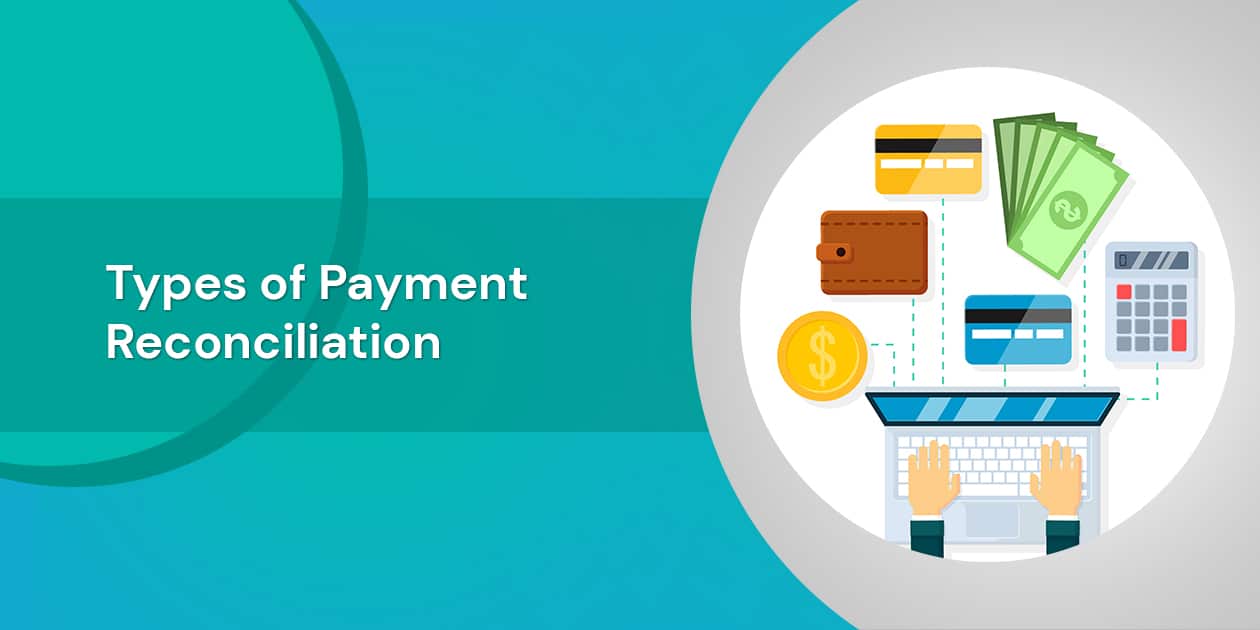
Different records call for different types of reconciliation. Financial institutions commonly run several at once.
| Type | What it matches |
| Bank reconciliation | Ledger cash balance against the bank statement |
| Card and gateway reconciliation | Card or gateway transactions against processor statements |
| Accounts receivable reconciliation | Customer payments and credit notes against issued invoices |
| Accounts payable reconciliation | Supplier invoices and payments against the payables ledger |
| Global currency reconciliation | Transactions in different currencies against exchange rates and settlement statements |
| Real-time payments reconciliation | Payments matched against internal records as they clear, before final settlement |
| Intercompany reconciliation | Transactions between entities in the same group |
| General ledger reconciliation | Individual ledger accounts against sub-ledgers and supporting documents |
Common Payment Reconciliation Challenges
Reconciliation sounds simple, but real transaction data rarely lines up cleanly.
| Challenge | What it looks like | What helps |
| Fees and settlement differences | Gross transaction values differ from net deposits because of fees, refunds and chargebacks | Line-by-line matching from gross capture to net payout |
| Cross-border complexity | Transaction and settlement currencies differ, and exchange rates and timelines vary | Record the quoted rate, the settled rate and both currencies for each transfer |
| Multiple sources and formats | Each processor, bank and partner uses different identifiers and file layouts | Standardize data and use a consistent reference across systems |
| No single source of truth | Different teams keep separate records that conflict | One ledger that every system reconciles against |
| High volumes | Manual matching is slow and error-prone | Automated matching with exception queues |
| Delayed closing | Slow reconciliation holds up month-end reporting and payouts | Daily matching instead of a month-end scramble |
Manual vs. Automated Payment Reconciliation:
Manual reconciliation relies on spreadsheets and data entry. It can work at low volume, but it breaks down as channels, currencies and partners multiply. Automated payment reconciliation uses software to match payment transactions with bank, processor and accounting records, so people only review the items that fail to match.
| Factor | Manual reconciliation | Automated payment reconciliation |
| Matching | People compare rows in spreadsheets | Software matches by ID, date and amount |
| Speed | Often monthly or weekly | Daily or near real time |
| Error risk | Higher, because of manual entry | Lower, because entry is removed |
| Exceptions | Found late, during review | Flagged as they arise |
| Scalability | Needs more staff as volume grows | Handles more volume without proportional effort |
| Audit trail | Depends on how well people document | Built-in log of matches and adjustments |
Automation does not remove people from the process. It changes their role. Instead of keying and comparing data, analysts investigate the exceptions and decide how to correct them.
Payment Reconciliation in Cross-Border Remittances
Remittances add layers that a typical online store never sees. One transfer can involve a sender’s payment, a quoted exchange rate, fees, a partner bank, a payout agent and a recipient in another currency. Each layer produces its own record, and each record has to agree with the others.
In practice, reconciling a transfer means checking that:
- The amount the sender paid matches the amount in the provider’s ledger and on the receipt the sender received.
- The exchange rate and fees recorded for the transfer match what the sender was shown.
- The payout confirmed by the partner matches the amount the recipient was supposed to get.
- The funds settled with the bank or partner match the sum of the individual transfers.
- Returned, canceled or refunded transfers are reflected in the ledger.
These checks are the same ones that decide whether a sender’s complaint can be resolved quickly. That is why we design around a single transaction record at Remit Anywhere.
Payment Reconciliation Examples
These examples show what reconciliation looks like when it fails and when it works. They are not Remit Anywhere customer case studies.
When Synapse’s Records Did Not Agree?
The collapse of fintech middleware provider Synapse in 2024 shows what happens when reconciliation fails at scale. According to NBC News, the bankruptcy trustee reported in June 2024 that customers of fintechs using Synapse had $265 million in balances, while the partner banks held only $180 million tied to those accounts. That put the early estimate of the gap at about $85 million, and the trustee later gave a range of $65 million to $96 million. Work to reconcile the ledgers between Synapse and the partner banks continued long after the failure.
The episode also shaped policy. In September 2024, the FDIC proposed a recordkeeping rule for custodial accounts that would require banks to keep detailed records of who owns the funds in certain accounts and to maintain internal controls over those records. The lesson holds whatever the final form of the proposal: when ledgers across partners cannot be reconciled, customers cannot be made whole quickly.
A Money Transfer Provider Reconciling a Daily Batch:
This is an illustrative scenario. A provider sends 1,000 transfers in one day. At close, its ledger shows 1,000 funded transfers. The partner’s payout report confirms 998, and two transfers are returned because of invalid recipient details. Automated matching flags the two items within minutes. The team confirms the returns, credits the senders, posts the adjustments and closes the day with every transfer accounted for. Without daily reconciliation, those two items could have sat unnoticed until a sender asked where the money went.
Payment Reconciliation Best Practices
- Reconcile on a regular schedule. High-volume providers often reconcile daily or weekly, so discrepancies are caught before they reach monthly reports.
- Separate duties. The person who records transactions should not be the same person who reconciles them.
- Document everything. Keep a record of each discrepancy, the cause and the adjustment, because auditors and examiners will ask for it.
- Set thresholds for unreconciled differences. Define the amount beyond which an item needs immediate investigation, so people prioritize correctly.
- Investigate exceptions promptly. Quick action makes it easier to recover funds and prevent repeats.
- Standardize your data. Use consistent references across the ledger, processors and partners.
- Automate wherever possible. Software removes manual entry and scales with volume.
- Review and approve. A supervisor should sign off on completed reconciliations.
This article is for general information and is not legal, tax or accounting advice. Confirm your obligations with a qualified professional in your jurisdiction.
Frequently Asked Questions
What is payment reconciliation?
Payment reconciliation is the process of matching transaction records across your internal ledger, payment processor reports and bank statements. It confirms that every payment is recorded correctly and that the cash received matches what your books show.
What causes payment reconciliation discrepancies?
Most discrepancies come from timing differences, fees and chargebacks deducted from settlements, refunds, duplicate or missing transactions, currency conversion differences and mismatched reference IDs. Matching at the transaction level shows which cause created the gap.
How does payment reconciliation work?
You collect records from your ledger, processors and bank, match transactions by ID, date and amount, and flag the ones that differ. You then investigate, adjust the books and have the result reviewed and documented.
What is payment gateway reconciliation?
Payment gateway reconciliation matches the transactions your gateway reports to processor settlement reports and bank deposits. It accounts for fees, refunds and chargebacks that make gross payments differ from the net amount deposited.
What is automated payment reconciliation?
Automated payment reconciliation uses software to match payment transactions with bank, processor and accounting records automatically. People review only the exceptions, which reduces manual work and errors.
How often should payments be reconciled?
High-volume businesses commonly reconcile daily or weekly, so discrepancies are found before month-end. Lower-volume businesses may reconcile monthly, but longer gaps make errors harder to trace.
What is the difference between bank reconciliation and payment reconciliation?
Bank reconciliation matches your ledger balance to the bank statement. Payment reconciliation goes deeper, matching individual transactions across internal records, processor reports and bank deposits.
What is the difference between reconciliation and settlement?
Settlement is the transfer of funds between parties to complete a transaction. Reconciliation usually comes afterward and checks that the records for that transaction match across systems.
Why is payment reconciliation important for financial institutions?
It catches errors and fraud early, keeps reporting accurate, supports audits and helps institutions resolve customer errors on time. Missing or mismatched records can also lead to funds shortfalls and compliance findings.
Conclusion
Payment reconciliation proves that the money your records say moved is the money that actually moved. Match transactions at the individual level, reconcile often, document every adjustment and automate the routine matching so your team can focus on exceptions. For financial institutions and money transfer providers, that discipline protects customers, keeps reports accurate and makes audits and error investigations far easier.
Reconcile Payments With Remit Anywhere
Remit Anywhere helps money transfer businesses keep transaction records, compliance and reporting in one place. Book a demo to see how reconciliation fits your payment flow.