
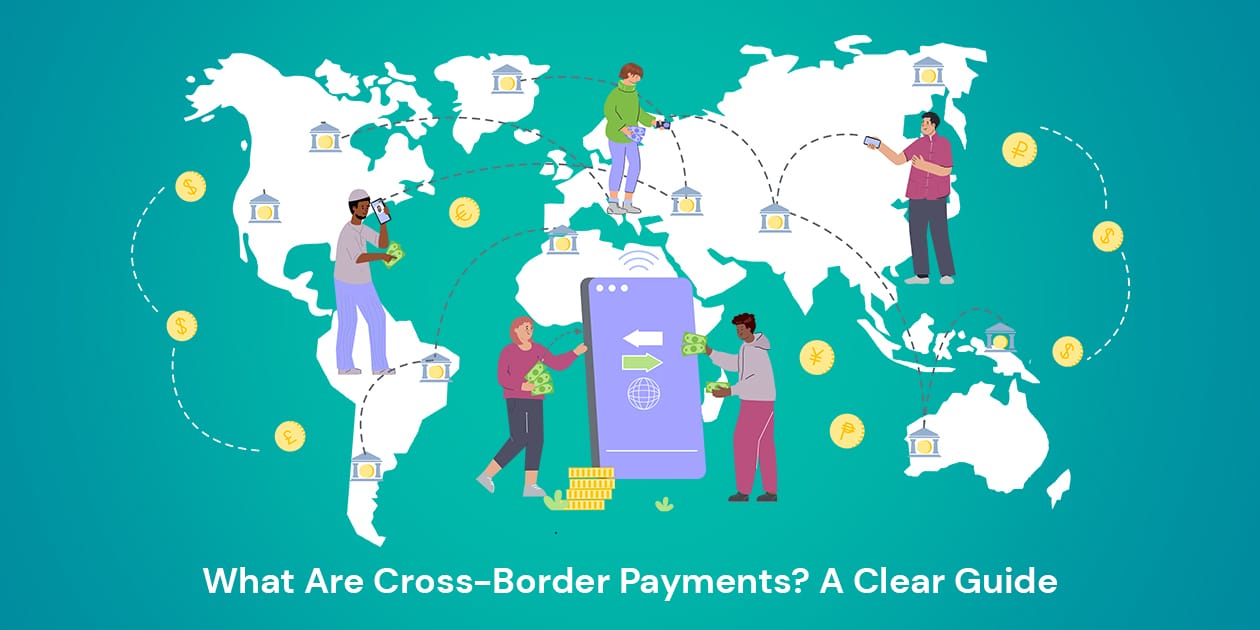
Cross-border payments are financial transactions where the payer and the recipient sit in different countries. The money often changes currency, passes through more than one bank or provider, and meets the rules of more than one regulator. That is why cross border payments cost more and take longer than domestic ones.
This guide explains the definition, the main types and who uses them, and how the process works step by step. It also covers market size, the benefits of cross-border banking, and how businesses can cut cost and delay. Figures come from the World Bank, the Financial Stability Board (FSB), and McKinsey, and the latest releases available in October 2026.
Key Takeaways
- A cross-border payment crosses a national border, a currency, or both, and often adds FX, intermediaries, and extra compliance checks.
- The FSB splits cross-border payments into three segments: wholesale, retail, and remittances.
- The World Bank puts the global average cost of sending $200 at 6.36% in Q3 2025, more than double the UN target of 3% by 2030.
- Remittances to low- and middle-income countries reached an estimated $685 billion in 2024.
- Digital services average 4.59% to send $200. Non-digital services average 7.30%.
- Cost, speed, and data quality are the three levers for cross-border payments optimization.
Cross Border Payments Definition: What the Term Means
A cross-border payment is any transfer of value between a payer and a recipient in different countries. The two parties can be people, businesses, banks, or governments. The payment may be in dollars, euros, or any other currency. Both the sender and the receiver may use different banking systems, ID formats, and rules.
Three things set these payments apart from domestic ones:
| Feature | Domestic payment | Cross-border payment |
| Currency | One currency | Often two or more, with an FX conversion |
| Intermediaries | Usually one payment system | Often several banks or providers |
| Rules | One regulator | Rules from both countries, plus sanctions screening |
| Data | Local formats | Mixed formats (IBAN, routing numbers, SWIFT codes) |
| Typical cost | Low | Higher: fees plus FX margin |
The World Bank tracks cost as two parts: a transfer fee and a foreign exchange margin. Both count toward what a sender pays. Many international money transfers carry both.
Types of Cross-Border Payments and Who Uses Them
By Payment Size: The FSB Segments
The FSB and the G20 group cross-border payments into three segments by value.
| Segment | Value | Who uses it | Examples |
| Wholesale | $100,000 or more | Banks, financial institutions, large corporates | Interbank settlement, treasury transfers |
| Retail | Under $100,000 and over $200 | Small businesses, marketplaces, consumers | Supplier payments, e-commerce, tuition, travel |
| Remittances | $200 or less | Migrant workers and their families | Money sent home |
By Use Case:
- B2B: Businesses pay suppliers, contractors, and partners abroad. These payments often run through bank wires.
- C2B and e-commerce: Shoppers pay foreign merchants by card or wallet.
- B2C payouts: Platforms pay sellers, creators, and freelancers in other countries.
- P2P and remittances: Individuals send money to family. Money service businesses (MSBs) handle much of this flow through the remittance process they run in each corridor.
By Payment Method:
Providers move money through six main methods, from bank wire transfers to stablecoins.
| Method | How it moves money | Typical users | Main trade-off |
| Bank wire (SWIFT) | Bank to bank, often through correspondent banks | Businesses, large transfers | Fees and speed vary by bank. |
| International ACH | Batch transfer between banks in linked schemes | Payroll, recurring B2B | Slower than instant methods |
| Cards | Card networks route the payment | Online shoppers, merchants | Network and FX fees |
| Digital wallets and MTOs | Provider holds funds and pays out locally | Remitters, freelancers | Cost depends on the provider |
| Local and instant rails | Domestic fast systems linked across borders | Growing retail and B2B use | Coverage differs by corridor |
| Stablecoins | Token-based settlement | Treasury and fintech programs | Rules still taking shape |
Retail checkout is changing too. Scan-to-pay options such as QR code payments and other digital payments now reach shoppers across borders in some markets.
How Cross-Border Payments Work
A typical payment follows these steps:
- Initiation. The sender gives the recipient’s name, account details, and amount. Details differ by country: IBAN in Europe, routing and account numbers in the US, and SWIFT codes between banks.
- Compliance screening. The sender’s provider runs KYC checks, applies AML compliance controls, and screens names against sanctions lists. In the US, the FinCEN Travel Rule requires providers to pass certain sender and recipient data along with larger transmittals.
- FX conversion. The provider converts the currency. The rate it applies, and its margin over the mid-market rate, adds to the cost.
- Routing. The payment travels through correspondent banks, a card network, a local rail, or a provider’s own network.
- Settlement and credit. The receiving bank or provider credits the recipient, who can then withdraw or spend the funds.
- Reconciliation. Both sides match the payment to invoices or customer records.
Each step has its own systems and failure points. Our guide to how cross-border payments work covers the banking flow, SWIFT messaging, and Nostro and Vostro settlement in depth.
Two recent changes affect this flow. Swift ended its coexistence period for MT and ISO 20022 cross-border messages in November 2025, so payment messages now carry richer, structured data. Since 9 October 2025, euro-area providers must also run Verification of Payee, which checks the name against the account before a payment leaves.
Cross Border Payments Market Size
Cross-border payments sit inside a very large industry. McKinsey’s 2025 Global Payments Report puts total payments revenue at $2.5 trillion in 2024, from $2.0 quadrillion in value flows and 3.6 trillion transactions. That figure covers all payments, not only cross-border ones. McKinsey expects revenue to reach $3.0 trillion by 2029 at 4% annual growth.
| Metric | Figure | Source |
| Global payments revenue, 2024 | $2.5 trillion | McKinsey, 2025 |
| Projected payments revenue, 2029 | $3.0 trillion | McKinsey, 2025 |
| Projected cross-border flows, 2030 | About $290 trillion (projection) | Industry report citing McKinsey estimates |
| Remittances to low- and middle-income countries, 2024 | $685 billion (up 5.8%) | World Bank |
| Global average cost of sending $200, Q3 2025 | 6.36% (9.67% in Q1 2009) | World Bank RPW, Issue 54 |
| Retail payments completed within one hour, 2025 | 35.4% (target: 75% by end-2027) | FSB, 2025 |
The top remittance recipients in 2024 were India ($129 billion), Mexico ($68 billion), China ($48 billion), the Philippines ($40 billion), and Pakistan ($33 billion), according to World Bank estimates. In 2023, remittances to low- and middle-income countries also exceeded foreign direct investment and official development assistance.
The World Bank’s cost data shows who charges what.
| Provider or channel | Average cost to send $200 (Q3 2025) | Cost in dollars |
| Banks | 14.99% | $29.98 |
| Post offices | 5.58% | $11.16 |
| Money transfer operators | 4.72% | $9.44 |
| Digital services | 4.59% | $9.18 |
| Non-digital services | 7.30% | $14.60 |
| Global average | 6.36% | $12.72 |
What Are the Benefits of Cross Border Banking?
Well-run cross-border banking and payments give businesses and families clear gains:
- Market access. Businesses sell to, hire from, and pay partners in more countries.
- Revenue diversity. Sales in several currencies and regions spread risk.
- Lower cost when optimized. Digital services cost about 2.7 percentage points less than non-digital ones on a $200 transfer (4.59% against 7.30%).
- Better customer experience. Local-currency payments and clear delivery times cut abandoned payments and support calls.
- Financial inclusion. Remittances give households in low- and middle-income countries a steady source of income and support local spending.
- Transparency. Showing the total cost up front, a goal in the FSB targets, helps senders compare options.
Cross-Border Payments Optimization: How to Cut Cost and Delay?
Small process changes can improve cost, speed, and success rates. Here are the main bottlenecks and fixes:
| Bottleneck | Fix | Result |
| One rail for every corridor | Match the rail to the corridor, size, and urgency | Lower cost, faster delivery |
| Hidden FX margin | Compare quotes against the mid-market rate and show total cost | Fewer surprises for senders |
| Bad beneficiary data | Validate names and account details before sending | Fewer returned payments |
| Unstructured data | Send complete, structured payment data (ISO 20022) | Fewer holds and queries |
| Manual screening | Automate KYC, AML, and sanctions checks | Faster onboarding and release |
| Manual reconciliation | Match payments to records through an API integration | Less staff time, fewer errors |
Track four numbers to see whether changes work: total cost per corridor, time to credit, first-time success rate, and manual touches per payment. The FSB’s 2025 data shows why it matters. Only 35.4% of retail cross-border payments reached the recipient within an hour, against a target of 75%.
Cost Example and Scenario
What a $200 Transfer Costs?
Take a $200 transfer. At the 6.36% global average, the sender pays about $12.72. Sent through a bank at 14.99%, the cost rises to $29.98. Sent by a money transfer operator at 4.72%, it falls to $9.44. The average cost of sending $200 to Mexico was 4.53% in Q3 2025, about $9.06. The same transfer sent from the US averaged 5.04%. Cost depends on the provider, the channel, and the corridor, so small differences compound at volume.
A Money Service Business Adds a Corridor:
This scenario is invented to show the idea. A US money service business sends funds to family members in several countries. It runs each corridor through a different bank, screens names by hand, and reconciles payments in spreadsheets. Each new country takes months. When it moves onto one remittance software platform, it screens senders and recipients in one place, reaches several payout partners through one integration, and matches payments automatically. It still confirms licensing and partner terms for every new market, but the core system stays the same.
How Remit Anywhere Supports Cross-Border Payments?
We build software for licensed money services businesses and remittance operators. Our platform brings agent-based, online, and mobile transactions into one system, so teams do not switch tools by channel. We build KYC and AML workflows into the transaction flow, so compliance teams see activity across channels in one place. We support multi-currency and multi-corridor operations as a core capability, and our reporting gives owners and compliance officers a view across the whole operation. Newer payout methods, such as NFC contactless payouts, are changing how MSBs pay out funds.
We build infrastructure for licensed, regulated businesses. Each MSB stays responsible for its own registration, licensing, and compliance program.
Frequently Asked Questions
1. What are cross border payments?
Cross border payments are transactions where the payer and the recipient are in different countries. They often involve a currency exchange, several banks or providers, and compliance checks in more than one country.
2. How do cross-border payments work?
The sender gives payment details, the provider screens the transfer and converts the currency, and the payment travels through banks or a local rail. The receiving bank or provider then credits the recipient.
3. How long do cross-border payments take?
It depends on the method and corridor. Banks tend to be slower than money transfer operators and mobile providers. The G20 target is for 75% of retail payments to reach the recipient within one hour by the end of 2027.
4. How much do cross-border payments cost?
The World Bank puts the global average cost of sending $200 at 6.36% as of Q3 2025. Banks average 14.99%, money transfer operators 4.72%, and digital services 4.59%. Costs include a transfer fee and an FX margin.
5. What are the main types of cross-border payments?
The FSB lists three segments: wholesale (over 200 or less). By use, they include B2B payments, e-commerce, payouts to sellers and freelancers, and money sent home.
6. What is the difference between a cross-border payment and a remittance?
A remittance is one kind of cross-border payment: a small transfer, usually $200 or less, sent by an individual to family abroad. Cross-border payments also cover business, wholesale, and e-commerce flows.
7. Are cross-border payments regulated?
Yes. Providers follow AML, KYC, and sanctions rules in each country they serve. In the US, money service businesses register with FinCEN and follow the Bank Secrecy Act and the Travel Rule.
8. How can a business reduce cross-border payment costs?
Match the payment rail to each corridor, compare FX quotes against the mid-market rate, validate beneficiary details before sending, and automate screening and reconciliation.
9. What is the cross border payments market size?
McKinsey puts total global payments revenue at $2.5 trillion in 2024. Remittances to low- and middle-income countries reached an estimated $685 billion that year, according to the World Bank.
Ready to Move Money Across Borders With Confidence?
Whether you run a growing money service business or a remittance network, a conversation with our team is the quickest way to map your corridors and compliance needs. Our plans page outlines the available options, and our FAQ page covers common platform questions.