
A payout partner is the licensed bank, wallet provider, or payout network that delivers a remittance to the recipient. The right one is licensed in the destination country, reaches your corridors, delivers on a stated timeline, screens every payment, and quotes its full cost up front.
At Remit Anywhere, we build the software that connects payout partners to a provider’s platform, so we see which questions matter before a contract is signed.
Key Takeaways
- A payout partner delivers funds in the destination country by bank deposit, cash pickup, mobile wallet, or card.
- Start with licensing and compliance. A U.S. remittance transfer provider is liable for violations by an agent acting for it (12 CFR 1005.35).
- Compare total cost, not the headline fee. The World Bank puts the global average cost of sending $200 at about 6.4% through 2025, against a 3% target for 2030.
- Test a live transfer in every corridor and payout method before you commit volume.
- Check how the partner handles failed and returned payouts, including refund timing, fees, and status codes.
- Ask how you fund payouts. Prefunding ties up working capital and changes your real cost.
- Plan a second partner for your largest corridors, so one outage does not stop your payouts.
What a Payout Partner Does in a Remittance Transfer
The payout leg is the last step in how the remittance process works. The sender pays, the provider screens and converts the funds, and the payout partner delivers local currency to the recipient. A payment processor collects the sender’s money, while a payout partner distributes it, so the two jobs need different checks.
| Payout method | How the recipient gets the money | What to check |
| Bank deposit | Funds are credited to the recipient’s account | Bank connectivity, cutoff times, name-matching rules |
| Cash pickup | The recipient collects cash at an agent location | Location count, opening hours, ID rules, agent liquidity |
| Mobile wallet | Funds land in a wallet on the recipient’s phone | Wallet licensing, cash-out network, wallet limits |
| Card | Funds are pushed to the recipient’s card | Card network coverage and issuer acceptance |
Some corridors need only one method. Others need all four. Your customers’ habits, not your preferences, should set the list.
IFAD’s 2026 report also found that more than half of remittances now begin digitally, yet only 35% of the services it measured in 2025 were fully digital from sender to recipient. Many transfers still end in cash pickup, so cash coverage still matters.
Why Payout Partner Choice Matters in 2026
Three facts show the stakes.
First, scale. Migrants sent an estimated $728.6 billion to low- and middle-income countries in 2025, according to IFAD’s Sending Money Home 2026 report, nearly double the level of 2016.
Second, cost. The global average cost of sending $200 stayed near 6.4% through 2025, and the World Bank’s third-quarter reading was 6.36%. The UN target in SDG 10.c is below 3%, with no corridor above 5%, by 2030. IFAD found that digital services averaged about 4.6%, against 7.3% for non-digital ones. In cross-border payments, every institution a transfer passes through adds cost, delay, and risk, so your payout partner’s fees and FX margin decide where your price lands.
Third, liability. Under 12 CFR 1005.35, a remittance transfer provider is liable for any violation of the Remittance Rule by an agent when that agent acts for the provider. In practice, a partner’s mistake becomes your mistake.

Core Criteria for Choosing a Payout Partner
| Criterion | Question to ask | Evidence to request |
| Licensing | Which regulator licenses you in the destination country? | License number and scope |
| Coverage | Which corridors and payout methods do you support today? | Corridor list with live methods |
| Speed | What is your measured delivery time by corridor? | Delivery data for the last quarter |
| Compliance | How do you screen payments and manage agents? | AML program summary, sanctions process |
| Cost | What fees and FX margin apply per corridor? | Written rate sheet |
| Technology | Which APIs, webhooks, and status codes do you offer? | API documentation and sandbox |
| Financial strength | How do you fund payouts and handle liquidity? | Settlement terms and prefunding rules |
| Service | What are your support hours and escalation steps? | Service level agreement |
Licensing and regulatory standing
Check the partner’s authorization in the country where it pays out, not only where it is headquartered. Ask who regulates it and what the license covers, such as bank deposits, cash pickup, or wallets. In the United States, money services businesses register with FinCEN and keep a written AML program under 31 CFR Part 1022, and most states also license money transmitters. Hold your payout partners to the same standard in their own markets.
Corridor and payout-method coverage
A long country list can hide thin coverage. Ask for the live methods in each corridor, the number of cash pickup locations, and the banks that accept direct deposits. Then test one transfer per corridor before you commit volume.
Delivery speed and settlement terms
Speed depends on the destination rail, cutoff times, and holidays. Ask for measured delivery times, not marketing claims. Also ask how you fund payouts. Some partners require prefunding, which ties up working capital, and others settle after delivery.
Compliance controls
Your partner should screen every payment against sanctions lists and keep records you can audit. FATF revised its Travel Rule, Recommendation 16, in June 2025 to strengthen the originator and beneficiary information that travels with cross-border payments. Ask how the partner collects, passes, and stores that data. Their answers should match your own AML controls.
Total cost and FX transparency
The World Bank measures remittance cost as the total of fees and exchange-rate margin. Use the same measure, and add the costs a rate sheet can hide: setup or subscription fees, minimum fees, intermediary deductions, funding costs, and charges for returned payments or investigations. Ask for written pricing for your own corridors and volumes. A low fee with a wide FX margin can cost more than a higher fee with a tight margin.
Technology and reporting
A payout partner is only as useful as its data. Look for clear APIs, webhooks for every status change, searchable transaction records, and reports that reconcile to your ledger. Payout data should flow into your remittance platform so reconciliation needs no manual rework.
Recipient validation, failed payments, and status tracking
Most payout problems start with bad recipient details or unclear status. Ask how the partner checks account and wallet details before it sends, what happens to a failed or returned payout, how fast the sender is refunded, and what it charges for retries. Each payout should carry a unique transaction reference and clear status codes, such as pending, completed, failed, and returned, so your team can reconcile without opening a support ticket.
Financial strength, service, and liability
Ask how the partner funds payouts when volumes spike, what happens in an outage, and who answers the phone at midnight in the destination country. Then read the contract for liability. Because of Section 1005.35, you cannot contract away your own responsibility for a U.S. consumer transfer, so choose partners you can supervise.
Case Study: What Weak Partner Oversight Cost One U.S. Remitter
This is a public enforcement record, not a Remit Anywhere client story. In August 2019, the Consumer Financial Protection Bureau issued a consent order against Maxitransfers Corporation, a Texas remittance provider.
The facts in the order are specific:
- Scale: from October 2013 to May 2017, the company processed about 14.5 million remittances. It used a network of more than 1,600 third-party agent locations in the United States and more than 19,500 payment locations in Mexico and Central and South America.
- The problem: almost every disclosure told senders the company was not responsible for errors made by banks or payment agents. The CFPB found that statement deceptive, because the Remittance Rule makes the provider responsible for its agents’ errors.
- The gaps: the company had no written error-resolution policies until November 2016, and the first policy was about a page and a half copied from the CFPB’s website.
- The result: a $500,000 civil money penalty, plus orders to keep a compliance management system and to train and oversee agents and service providers.
What this teaches payout partner selection
The lesson is ours, not the CFPB’s:
- A large payout network does not transfer your legal duties to the network.
- Your disclosures, error-resolution process, and partner oversight must match the rules, whatever your contract says.
- Ask every partner how it handles errors, refunds, and complaints, and test that process before launch.
Other Partners in the Payment Chain
A payout partner is one link in the chain. Senders still need a way to pay in, and your platform still needs processors and bank connections. If you are choosing those partners next, we cover pay by bank options, contactless terminals for agent locations, and payment processors in separate guides.
How We Connect Payout Partners at Remit Anywhere
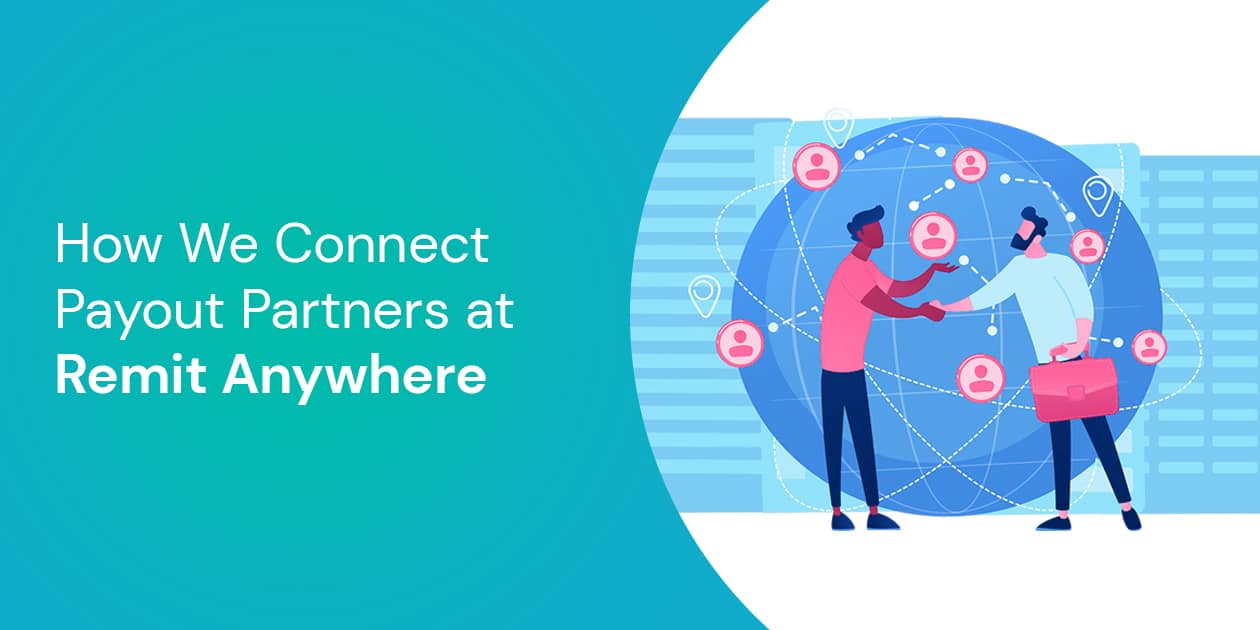
We are a technology provider, not a payout network. Our remittance software is an API-first, white-label platform for licensed money transfer organizations, banks, fintech startups, and payment providers. Our API layer connects banks, payment processors, payout partners, and compliance providers to one platform.
Here is how that supports the criteria above:
- One place to manage activity: agent management, online transfers, and compliance tools sit in a single platform.
- Compliance workflows: KYC and AML checks, transaction monitoring, and regulatory reporting are built in.
- Corridors and currencies: the platform supports multiple currencies, and its modular design lets you add corridors without rebuilding your stack.
- Your brand and workflows: white-label options, custom workflows, and branded interfaces let you run the platform under your own name.
You decide which payout partners to use, and we connect them to your platform. The platform serves startups and enterprises alike, with plans sized to match.
A Step-by-Step Process for Choosing a Payout Partner
- Map your corridors, recipient types, payout methods, and expected volumes, and separate must-haves from nice-to-haves.
- Shortlist partners that hold licenses in each destination country.
- Request documents: licenses, an AML program summary, the sanctions screening process, financial statements, service levels, and a written rate sheet.
- Score each partner on one scorecard.
- Run a test: send a small live transfer in each corridor and time every status change.
- Review the contract for liability, prefunding, suspension and reserve rights, termination, data ownership, and audit rights.
- Launch in one corridor first and track delivery time, error rate, and complaint volume. Then add a second partner for your largest corridors, so one outage does not stop your payouts.
- Re-score every year, and after any change in ownership, license, or regulation.
An illustrative scorecard
The weights below are an example, not a standard. Adjust them to your corridors and risk appetite.
| Category | Illustrative weight |
| Licensing and compliance | 25 |
| Coverage | 20 |
| Speed and reliability | 20 |
| Total cost | 15 |
| Technology and reporting | 10 |
| Financial strength and support | 10 |
| Total | 100 |
If you want to compare payout integrations inside one platform, tell us your corridors and volumes. Our team can walk you through how partners connect. You can reach us through our contact page or at +1 646-722-9500.
Red Flags to Watch For
- The partner cannot show a license for the destination country.
- The corridor list is long, but live methods are vague.
- The quoted fee leaves out the FX margin.
- The contract says the partner is not responsible for its agents’ errors, the same type of statement the CFPB found deceptive in the Maxitransfers case.
- There is no sandbox, status codes, or reconciliation data.
- The partner will not share measured delivery times.
- The partner demands prefunding without clear terms for returning unused funds.
- There is no written process for complaints and error resolution.
Frequently Asked Questions
1. What is a payout partner in remittance?
A payout partner is the licensed bank, wallet provider, or payout network that delivers a remittance to the recipient in the destination country. It pays out by bank deposit, cash pickup, mobile wallet, or card.
2. How do I choose a payout partner for a remittance business?
Check licensing and compliance first, then coverage, delivery speed, total cost, technology, and financial strength. Score each partner on one scorecard and test a live transfer in every corridor before you commit volume.
3. What licenses should a payout partner hold?
The partner needs authorization from the regulator in each country where it pays out, covering the methods it offers. In the United States, money services businesses register with FinCEN, keep a written AML program, and in most states also hold a state license.
4. Is a remittance provider responsible for its payout agents’ mistakes?
For transfers covered by the U.S. Remittance Rule, yes. Under 12 CFR 1005.35, a provider is liable for any violation of the rule by an agent acting for it, so you must supervise partners and cannot disclaim their errors.
5. How much does it cost to pay out a remittance?
The World Bank puts the global average cost of sending $200 at about 6.4% through 2025, including fees and the exchange-rate margin. Ask every partner for both, because the margin often hides the real cost.
6. What is prefunding?
Prefunding means you deposit money with the payout partner before it pays recipients, so it can deliver funds right away. It ties up working capital and creates a balance you must watch in each corridor. Ask how the partner reports your balance, how fast you can top up, and how you get unused funds back.
7. How many payout partners do I need?
There is no fixed number. Plan at least one partner for each corridor and payout method you serve, and a second partner for your largest corridors so an outage or license problem does not stop payouts. Add backups where volume or risk is highest.
8. How do I test a payout partner?
Send small live transfers in each corridor and payout method, and time every status change from instruction to credited funds. Test failures on purpose, such as a wrong account number, and check refund timing, fees, and status codes. Reconcile every test payout to your ledger before you commit volume.
9. What happens when a payout fails or is returned?
The partner should retry or return the funds under written terms, and your platform should show a clear status and transaction reference. Ask how fast the sender is refunded and what the partner charges for failed payments. For U.S. transfers covered by the Remittance Rule, you must also follow its error-resolution procedures.
10. How does Remit Anywhere work with payout partners?
We provide an API-first, white-label remittance platform that integrates with banks, payment processors, payout partners, and compliance providers. You decide which partners to use, and our team can explain how each connection would work for your corridors.
Ready to Connect Your Payout Network?
Tell us your corridors, payout methods, and expected volumes, and we will show how your partners would connect to the platform. You can sign up for free to explore it, call us at +1 646-722-9500, or write to info@remitanywhere.com.